Boaz Almog of Tel Aviv University demonstrates Quantum Levitation, which could turn out to be the key to the future of transportation and energy

EYE ON A CRAZY PLANET
Showing posts with label Quantum Physics. Show all posts
Showing posts with label Quantum Physics. Show all posts
Sunday, October 23, 2011


Sunday, September 25, 2011
Warp factor four, Mr. Sulu - Star Trek anticipated scientific discovery 35 years before scientists
Einstein's theory postulated that nothing could travel faster than the speed of light.
Star Trek's warps were multiples of that speed which was an aspect of the science fiction show that bothered physicists.
Until last Thursday, when the CERN accelerator in Switzerland observed neutrinos, a sub-atomic particle, travel faster than Einstein's speed limit.
Star Trek's warps were multiples of that speed which was an aspect of the science fiction show that bothered physicists.
Until last Thursday, when the CERN accelerator in Switzerland observed neutrinos, a sub-atomic particle, travel faster than Einstein's speed limit.
Sunday, January 23, 2011
Can Quantum Physics explain shared fates that transcend time and space?
From WIRED:
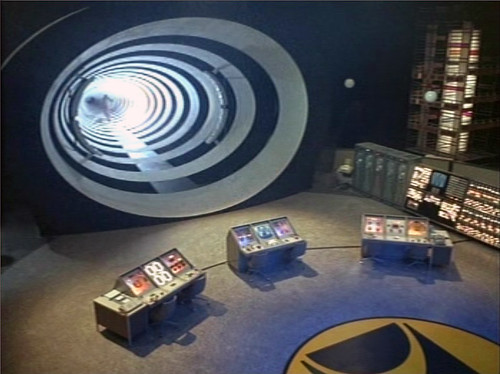 In the weird world of quantum physics, two linked particles can share a single fate, even when they’re miles apart.
Now, two physicists have mathematically described how this spooky effect, called entanglement, could also bind particles across time.
If their proposal can be tested, it could help process information in quantum computers and test physicists’ basic understanding of the universe.
“You can send your quantum state into the future without traversing the middle time,” said quantum physicist S. Jay Olson of Australia’s University of Queensland, lead author of the new study.
In ordinary entanglement, two particles (usually electrons or photons) are so intimately bound that they share one quantum state — spin, momentum and a host of other variables — between them. One particle always “knows” what the other is doing. Make a measurement on one member of an entangled pair, and the other changes immediately.
Physicists have figured out how to use entanglement to encrypt messages in uncrackable codes and build ultrafast computers. Entanglement can also help transmit encyclopedias’ worth of information from one place to another using only a few atoms, a protocol called quantum teleportation.
In a new paper posted on the physics preprint website arXiv.org, Olson and Queensland colleague Timothy Ralph perform the math to show how these same tricks can send quantum messages not only from place to place, but from the past to the future.
read more about this fascinating article at Wired and the original paper upon which it was based at arXiv.org
Now, two physicists have mathematically described how this spooky effect, called entanglement, could also bind particles across time.
If their proposal can be tested, it could help process information in quantum computers and test physicists’ basic understanding of the universe.
“You can send your quantum state into the future without traversing the middle time,” said quantum physicist S. Jay Olson of Australia’s University of Queensland, lead author of the new study.
In ordinary entanglement, two particles (usually electrons or photons) are so intimately bound that they share one quantum state — spin, momentum and a host of other variables — between them. One particle always “knows” what the other is doing. Make a measurement on one member of an entangled pair, and the other changes immediately.
Physicists have figured out how to use entanglement to encrypt messages in uncrackable codes and build ultrafast computers. Entanglement can also help transmit encyclopedias’ worth of information from one place to another using only a few atoms, a protocol called quantum teleportation.
In a new paper posted on the physics preprint website arXiv.org, Olson and Queensland colleague Timothy Ralph perform the math to show how these same tricks can send quantum messages not only from place to place, but from the past to the future.
read more about this fascinating article at Wired and the original paper upon which it was based at arXiv.org
Subscribe to:
Posts (Atom)