Featured Post

How To Deal With Gaza After Hamas

Showing posts with label Iraq. Show all posts

Monday, September 9, 2013

Known Unknown: A Documentary of Historical Significance

It's very rare that a movie is something of historical significance, but one that does fall into that category played last night at the Toronto International Film Festival.

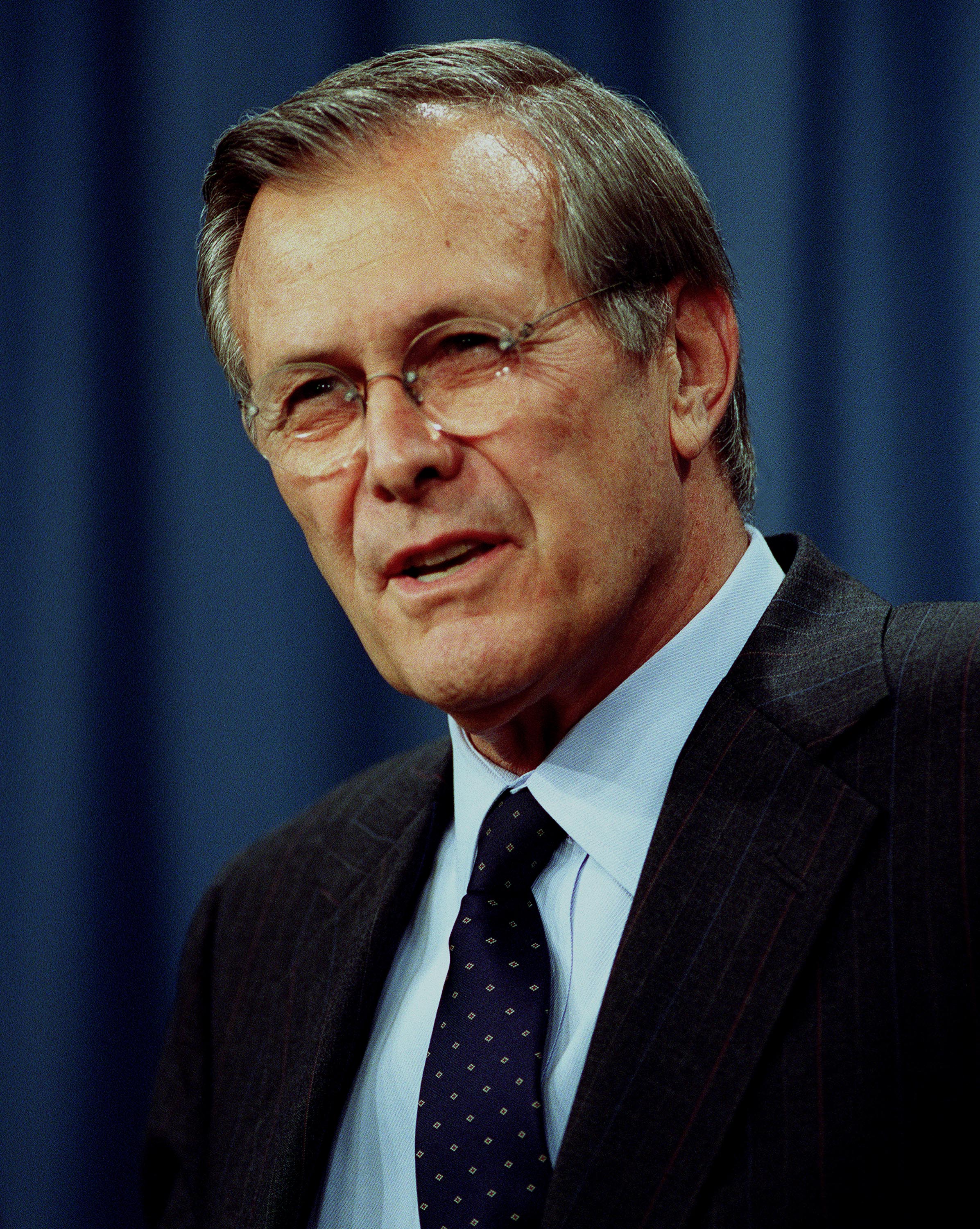
Errol Morris' Known Unknown is a two hour documentary that the director pared down from over thirty hours of interviews he filmed with former US Defense Secretary Donald Rumsfeld.

Those who remember him from the press conferences he held for the Defense Department during the second Iraq War will recall Rumsfeld's acerbic wit. That wit is on full display in Morris' film, but we get much more. The audience also gets to witness the thoughtfulness and the keen awareness of history Rumsfeld possesses, as well as valuable insights into the ways by which decisions that shaped tumultuous world events were formed.

Like in his earlier film The Fog of War, Morris wisely lets his subject to almost all the talking. We only hear Morris a handful of times in the film. Much of what we hear in Known Unknown is Rumsfeld reading from among the countless memos, which he called his "snowflakes," that he sent during his tenure as a senior official in the administrations of US presidents Nixon, Ford, Reagan and George W. Bush.

Known Unknown should be compulsory viewing for anyone who believes the insane conspiracy theories about the September 11, 2011 terror attacks. Conspiracy theorists operate under the misconception that government and its leaders are all-knowing and powerful. Hearing just how much that is not the case from someone like Rumsfeld could be an enlightening revelation for them.

One of the times we hear from Morris in the film, he accuses Rumsfeld of having a particular obsession with Iraq, which the former Defense Secretary convincingly refutes. However it's Morris' own obsession with the contradictions that he believes Rumsfeld embodies that drives the tone of his movie.

Rumsfeld has been vilified by many who detest the last President he served, George W. Bush and in the talk Morris gave following the Toronto screening of his movie, it was easy to get the sense the director shared at least some disdain for his subject. But Morris the filmmaker is too honest and too fine a craftsman to have let those feelings interfere with his compelling finished product, which is dramatically enhanced by Danny Elfman's brilliantly eerie score.

As a matter of due disclosure, I should note that I worked for Participant Media, one of the companies responsible for producing Known Unknown. I was the person who first introduced the idea of attaching specific social action campaigns and goals to the organization's movies; an approach that worked most notably for their documentary An Inconvenient Truth.

There are convincing arguments to be made on both sides about whether Al Gore is a visionary genius who spurred the world into staving off environmental suicide or a narcissistic dilettante pushing junk science. But in either case, there is no dispute that An Inconvenient Truth has been enormously influential. It is used as a teaching tool in schools all over the world and has been instrumental in shaping the perceptions about Global Warming.

But it's actually Participant's new movie, Known Unknown, which will be of lasting historical significance and is of indisputable educational value. The contradictions that bothered Morris so much are part of an unavoidable dilemma faced by those in positions of power faced with making momentous decisions. They are inundated with innumerable reports and prognostications where much of the information they receive is filled with conflicting data.

At the end of the day, the people who made decisions like those in the White House who chose to pursue the war in Iraq are fallible human beings. There is no certainty to any choice until it can be viewed in retrospect, and sometimes not even then. So while it may be easy for some to condemn Rumsfeld or George W. Bush for the course they steered, they chose what they thought was the best course of action in Iraq based on the information they had.

Known Unknown will be a satisfying experience for anyone who sees it, since people on either side of the divide over the Iraq war will not only gain insight but will be able to find ways of having their own prejudices confirmed. However, regardless of one's ideological outlook, witnessing that people with the humanity and cognisance of a Rumsfeld have to grapple with the difficulties he faced in the ways he did is something everyone should see. Morris and Rumsfeld make that predicament abundantly clear in Unknown Known.

Morris may be critical of the way his subject chose to act. But we can see from the current Middle East crisis and the ineptitude with which the current American President has handled it, that failing to act is in itself a decision. And as we are observing in real time from Barack Obama, not acting decisively can often do more damage than a flawed decision.

Thursday, September 20, 2012

Is the NDP accusing Obama of running a repressive regime?

In his last election campaign, Jack Layton said he was `Canada`s Barack Obama` (obviously wishful thinking from a socialist with with a lot less intellect and charisma than the former Harvard law prof).

Is Layton`s party now accusing Obama of running a repressive regime from which refugees need sanctuary?


Sunday, December 18, 2011

Sunday, June 12, 2011

The Syrian tinderbox could spread

There have been previous reports from other flashpoint towns of conscripts being shot for refusing to open fire on civilians, always officially denied. But the unprecedented regime casualty list in Jisr al-Shughour suggests the rot is spreading inside the many-headed security apparatus. Assad now faces two revolts. One on the streets, another within his own power structures. Like autocrats elsewhere, he will discover you cannot shoot down an idea.

By trying to externalise the conflict away from Syria's cities into the wider region, effectively projecting it on to Israel and potentially Lebanon and Iraq too, the regime poses a greater threat to western and Israeli interests than at any time since the 1973 Ramadan (Yom Kippur) war.

France and others are finally waking up to this evolution, with Paris demanding UN security council action. There is talk of referrals to the international criminal court. The US is considering even tougher sanctions. Assad's legitimacy "if not gone, [has] nearly run out", says Hillary Clinton. Nobody is talking about military measures, not yet at least. But momentum is building. Meanwhile William "behind-the-curve" Hague remains publicly fixated on his misjudged pursuit of Libya's Gaddafi and a Yemeni boatlift – all but oblivious to the vastly more dangerous implications of a Syrian implosion.

Recent incursions into the Israeli-occupied sectors of the Golan Heights, orchestrated by Damascus, dramatically illustrate how the Syrian conflagration could be purposefully spread. And what price a completed US withdrawal from Iraq this year if the country is destabilised by a spillover flood of Syrian combatants and refugees?

Read the entire article by Simon Tisdall at The Guardian

Sunday, May 1, 2011

Tuesday, December 7, 2010

WikiLeaks explain how Iranian Revolutionary Guards evaded terror group designation

A classified cable from 2007, released recently by wiki-leaks. revealed that the Iranians had promised security cooperation in Iraq, but only if their Revolutionary Guards did not receive a terror group designation:

"Iran Revolutionary Guard Corps (IRGC) xxxxxxxxxxxx told London Iran Watcher xxxxxxxxxxxx  that Iran's cooperation on security in Iraq, though not yet evident, would be forthcoming, but in the same breath argued that a U.S. terrorist designation of the IRGC would prevent any such cooperation."

There has, for a long time, been a movement to have the Iranian Revolutionary Guards listed as a terror group in the west. There are clear terror links to them and they have a history of support for terrorism.

The leak helps explain why that designation may not yet have occurred.

The cable also confirmed the role of Iran in formenting terror and violence in Iraq and Afghanistan:

"for the USG to hold its hand on designation came xxxxxxxxxxxx engaged with the invited group at length on Tehran's view of U.S.-Iran relations, Iraqi security, and the nuclear issue. xxxxxxxxxxxx candid remarks, which included extremely vigorous exchanges with xxxxxxxxxxxx alternated between aggressive characterizations of Iran's relations in the Persian Gulf, admissions of the IRGC's presence and role in Iraq and Afghanistan, and apparently earnest statements of Iran's desire for cooperation with the United States."

Yet despite their remaining off the US State Department's list of terror groups, the Iranians failed to keep their word, as a subsequent cable in 2009 reveals:

Islamic Revolutionary Guard Corps - Quds Force (IRGC-QF) officers are active in Iraq, conducting traditional espionage and supporting violent extremists as well as supporting both legitimate and malign Iranian economic and cultural outreach. Iraqis and their government have demonstrated increasing willingness to push back against malign Iranian influence in the last year. Working with the Iraqis, we have succeeded in stopping some IRGC-QF activity through military operations and diplomatic engagement, while we prevented some IRGC-QF officers from entering Iraq through explicit warnings that we would target them unilaterally.


You can read the entire 2007 wiki leak below (click each one to enlarge)


Pt 1


Pt 2


Pt 3


Pt 4

Thursday, November 18, 2010

Bob Woodward discusses Iraq, Afghanistan, Bush and journalism

Bob Woodward discusses the wars in Iraq and Afghanistan, the Bush presidency and the state of contemporary journalism with Justine Rosenthal of The National Interest

Thursday, November 11, 2010

Is this one of the Republicans who could defeat Obama in 2012?

Recently elected congressman for Florida's 22nd district, Allen West has a fascinating history.

According to Wikipedia:

West is a graduate of the University of Tennessee and obtained his master's degree in political science at Kansas State University. He also holds a Master of Military Arts and Sciences from the U.S. Army Command and General Staff Officer College in political theory and military history and operations.

West's awards and decorations include the Bronze Star; Meritorious Service Medal; (two Oak Leaf Clusters); Army Commendation Medal (two Oak Leaf Clusters, one Valor Device); Army Achievement Medal (one Oak Leaf Cluster); Valorous Unit Award; Air Assault Badge and the Parachutist Badge.

In addition, West has been awarded the following service medals and ribbons: National Defense Service Medal (with bronze star device); Southwest Asia Service Medal; Army Service Ribbon; Army Overseas Service Ribbon (multiple awards); Saudi Arabia Kuwait Liberation Medal W/Palm Tree and Kuwait Liberation Medal.

What is particularly interesting about West is the way his military career ended:

While serving in Taji, Iraq, on August 20, 2003, as commander of the 2d Battalion, 20th Field Artillery Regiment, Lieutenant Colonel West was in charge of an interrogation of a civilian Iraqi police officer who was suspected of having pertinent information regarding attacks on American soldiers in the area. Interrogators had learned that the detainee had information about a planned ambush. When the interrogators were unable to extract the needed important information for some time, LTC West was asked to come try to obtain the important information. As the detainee continued to hold back the information, LTC West fired his pistol past the detainee's head into a clearing barrel, frightening (but not physically harming) the detainee and getting him to finally give the information. According to Lt. Col. West's sworn statement, the detainee informed West that:


“ [The attack] was to occur Friday morning in Saba al Boor vicinity of the police station by positioned snipers supposedly being brought in from Fallujah. [The detainee] was to ID my vehicle and myself for these rooftop firers. We took this information and the following day established flask CPs and used AH-64s overhead. There was no attack and no further attacks have emanated from the town since the apprehension of [the detainee] and his named associates. ”


At least one man was apprehended as a result of the information obtained through the detainee's interrogation. His home was searched, but no plans for attacks on Americans or weapons were found. Colonel West testified that he did not know whether "any corroboration" of a plot was ever found, adding: "At the time I had to base my decision on the intelligence I received. It's possible that I was wrong about [the detainee,] Mr. Hamoodi."


West, who at the time was just short of having 20 years of service, was charged with violating articles 128 (assault) and 134 (general article) of the Uniform Code of Military Justice. West was processed through an Article 32 hearing in November 2003, where he admitted wrongdoing, was fined $5,000 over two months for misconduct and assault. He then submitted his resignation, and was allowed to retire with full benefits in the summer of 2004.


At a hearing, West was asked by his defense attorney if he would do it again. "If it's about the lives of my men and their safety, I'd go through hell with a gasoline can," he said. Apparently not knowing West's gun was aimed into a barrel, "Hamoodi cracked and gave information about the planned ambush on West's convoy, thwarting the attack." West said there were no further ambushes on U.S. forces in Taji until he was relieved of his leadership post on October 4." "After West's resignation was brought to public attention the next fall, he received over two thousand letters and e-mails from the American public offering him moral support. In addition, a letter was drafted to the Secretary of the Army, its signatories being ninety-five members of Congress in West's support.

This interview with Congressman-elect West is worth watching. In it, he makes the cogent point that the "War on Terror" is not only not over but the term itself is a misnomer. He accurately observes that terror is not an enemy, but a tactic and uses the example that World War 2 was not a war on "Blitzkrieg" but a war against fascism. The "War on Terror" is nothing other than a war on extremist Islam, even though few in the White House want to say that out loud.


h/t stubble jumping redneck

Wednesday, October 13, 2010

Obama's new National Security Advisor, Tom Donilon

Donilon is a protege of Warren Christopher, who was a realist as Secretary of State during Bill Clinton's first term. Christopher and Donilon pushed for America to remain aloof from the Balkans war. Donilon raised his eyebrows over Madeleine Albright's approach to foreign policy during the Clinton years. He is a believer in quiet diplomacy. Donilon, a seasoned operator and lawyer, who first worked in the Carter administration, will push for decoupling from Afghanistan and Iraq.
read the rest at The National Interest