Now that copyright protections have expired on nearly all of Sir Arthur Conan Doyle's tales about the pipe-puffing detective in the deerstalker hat, are writers free to depict the character in new mysteries without seeking permission or paying license fees?
A federal judge in Chicago says yes, so long as they don't stray into territory covered in the 10 stories still protected by copyright. Not so fast, says the Doyle estate, which is considering an appeal this month. Descendants of the Scottish physician and author argue he continued to develop the characters of Holmes and Dr. Watson in the later works so they should remain off-limits until the remaining copyrights run out at the end of 2022....

EYE ON A CRAZY PLANET
Showing posts with label literature. Show all posts
Showing posts with label literature. Show all posts
Friday, January 3, 2014
Sherlock Holmes and the Case of The Public Domain


Friday, March 22, 2013
More than a year after his death, Communist idiots are still infuriated Christopher Hitchens turned his back on them
From a review of The Trial of Christopher Hitchens in the moronic, neo-Marxist website rabble.ca, published by the same-sex spouse of NDP Deputy Leader Libby Davies:
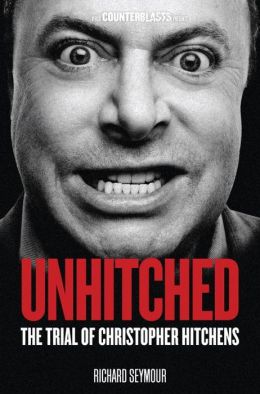 The review is peppered with the predictable vapid Marxist jargon; reactionary, comrades, revolutionary socialism, McCarthyist and so on...
It reeks of the unintentionally self-parodying, hysterical outrage that only a stupid western Marxist could muster.
Immediately after the September 11 attacks, he spoke of caution, of not veering into overreaction, yet soon he was picking fights with anyone who dared question U.S. reaction or even contextualize the attacks as "Anti-American" or worse. His early smears of Noam Chomsky and many others allowed for the entry -- even into some quarters of the Left for a short time -- of talk of loyalty and patriotism.
Hitchens became the patron saint of what some came to call "The Decent Left," those who signed the "Euston Manifesto." Seymour’s first book, The Liberal Defence of Murder, gives a history and analysis of this tendency, and is well worth the read. But Hitchens went far beyond even the "decent left" in his calls for civilizational warfare, his shocking and even genocidal Islamophobia (stating that he refused to share a planet with this "enemy"), even, tragically, his disavowal of his early and stalwart anti-Zionism.
It reeks of the unintentionally self-parodying, hysterical outrage that only a stupid western Marxist could muster.
Tuesday, December 4, 2012
Yay! Canadian sort of distinguishes herself by winning Bad Sex in Fiction Award
 |
| Author Nancy Huston |
Auberon Waugh established the prize in 1993 to draw attention to the “crude, tasteless, and often perfunctory use of redundant passages of sexual description in contemporary novels, and to discourage it.”...
“Infrared” tells the story of a painful Florentine family holiday endured by Rena Greenblatt, a photographer who takes infrared images of her lovers at intimate moments.
“The Canon is part of my body,” Huston’s heroine confides. She isn’t coy when it comes to describing her encounters.
“Kamal and I are totally immersed in flesh, that archaic kingdom that brings forth tears and terrors, nightmares, babies and bedazzlements. The word pleasure is far too weak for what transpires there. So is the word bliss.”
Instead, she tries musical metaphors, bad Italian and images of “undulating space where the undulating skies make your non-body undulate.”
Tuesday, March 13, 2012
Huxley explains to Orwell why Brave New World is more prescient than 1984
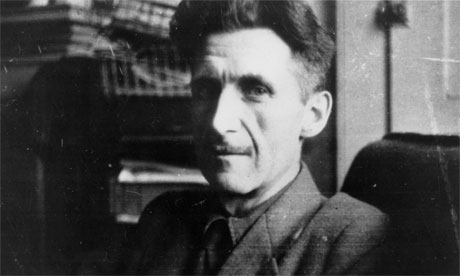
 From the marvellous site Letters of Note we have
Aldous Huxley's letter to George Orwell complimenting him on 1984 but explaining why his own novel, Brave New World, was more likely a better prediction of the future..
The first hints of a philosophy of the ultimate revolution — the revolution which lies beyond politics and economics, and which aims at total subversion of the individual's psychology and physiology — are to be found in the Marquis de Sade, who regarded himself as the continuator, the consummator, of Robespierre and Babeuf. The philosophy of the ruling minority in Nineteen Eighty-Four is a sadism which has been carried to its logical conclusion by going beyond sex and denying it. Whether in actual fact the policy of the boot-on-the-face can go on indefinitely seems doubtful. My own belief is that the ruling oligarchy will find less arduous and wasteful ways of governing and of satisfying its lust for power, and these ways will resemble those which I described in Brave New World.
Sunday, October 9, 2011
Terry Glavin is launching his new book, Come From The Shadows
Terry has presented a view of the complexities in Afghanistan that readers seldom get in the pages of Canada's newspapers.
He's already ruffled some feathers with it.
He's already ruffled some feathers with it.
Sunday, May 22, 2011
The irrelevant English letters crowd nips at the heels of Martin Amis
STANDPOINT magazine has a fascinating online article by David Barrett about the argument in England over one of its most talented writers, Martin Amis. You can read it all through this link. Some excerpts below:
"Writers die twice," wrote Martin Amis, "once when the body dies, and once when the talent dies." In the case of Philip Larkin, it was decided that two deaths weren't enough. The dead bores attacked the poems as dead bores do: by trashing the dead man's reputation. When he went to the grave in 1985, Larkin was known by many people to be a great poet. Eight years later — after the publication of the first Collected Poems, the Selected Letters and the Life — Larkin was known by many more people to be a racist, a womaniser, a porn collector and a drunk. It was soon questioned whether Larkin wrote great poetry. Then it seemed irrelevant that he wrote poetry at all.
A few serious writers stood up for Larkin with sensible words. Martin Amis was one of those writers. Clive James was another. They said what mattered, and what still matters: that Larkin had talent, and that the man's private failures were a private affair, because the man chose to keep them that way. Amis was still defending Larkin in October. On Letters to Monica he wrote that "Larkin's life was a failure; his work was a triumph. That is all that matters. Because the work, unlike the life, lives on." In September, Faber will publish the Selected Poems of Philip Larkin. The poems are chosen by Martin Amis.
-- -- --
Many people who write about literature think that Martin Amis's talent is dead. That talent, apparently, fell terminally ill about the same time as Larkin's funeral: in the mid 1980s, after the publication of Money. One reviewer, writing in The Sunday Times in 2003, offered a neat summary of this popular opinion in the press. London Fields (1989) and The Information (1995) "threw into embarrassing relief the meagreness of his fictional repertoire". Einstein's Monsters (1987) and Heavy Water (1998) "showed that even the short story format couldn't curb his tendency to meander and repeat". "Two experimental novellas", Time's Arrow (1991) and Night Train (1997), "both proved ill-judged". In Koba the Dread (2002) Amis sounded "even more egotistical than he did in his autobiography, Experience [2000]". Yellow Dog (2003) "ends with a baby getting triumphantly up on to its feet. But the impression it leaves is of a talent on its last legs."
..True literary style is unique. It's a voice heard above the immense hum of printed words. For Nabokov, style was matter. For Amis, style is perception: "It's not the flashy twist, the abrupt climax, or the seamless sequence of events that characterises a writer and makes him unique. It's a tone, it's a way of looking at things." A unique voice on the page provokes a unique response. No two readers can react to a real prose style in the same way. Yet many literary journalists try to persuade us that that's exactly what happens when they read a new Martin Amis novel. The style they use to describe his work is almost always the same. There are, of course, occasional warm reviews. The Pregnant Widow, rereleased in March in a Vintage paperback edition, was briefly praised in the Guardian and The Independent recently. But it is true to say that there's a consensus on Amis's work that is wholly unrelated to the quality of his words. The tale of Amis's dead talent is so popular in the press nowadays that it's a cliché. The cliché is betrayed by the dead boring style adopted by many writers when they write about Amis.
Even worse is the consensus on Amis as a person. He's Keith Talent. He's a very bad guy. In Larkin's case, the vicious ad hominem attacks began after he died. In Amis's case, personal abuse already passes for legitimate literary criticism. Critics have accused Amis of racism, misogyny and egotism. He's vain (the teeth), and greedy (the £500,000 advance, the Manchester University salary). He's "ageist", a shameless self-promoter and "past HIS sell-by date" (the euthanasia drama). He sprouts "arrogant twaddle" (the children's writing melee). Professor Terry Eagleton famously shot a rocket at the House of Amis: "[Kingsley Amis was] a racist, anti-Semitic boor, a drink-sodden, self-hating reviler of women, gays and liberals." Eagleton added that: "Amis fils has clearly learnt more from him than how to turn a shapely phrase."
Subscribe to:
Posts (Atom)