What's worse than the silence of Western Christians concerning the Muslim persecution of their coreligionists in the Islamic world? Answer: Cynically exploiting that persecution for a political agenda—in the case of a recent Daily Beast article, to excoriate the state of Israel and its supporters.
Titled "Why Won't the West Defend Middle Eastern Christians?" and written by Diarmaid MacCulloch, a Fellow of St. Cross College, the article touches on the persecution of Christians, but primarily as a springboard to attack American Christian support for Israel. Consider the following excerpt:
… one of the silences which I find most frustrating is precisely the lack of noise from Western Christians about the fate of ancient Christianities in the Middle East. At the heart of the problems in the Middle East is seven decades of unresolved conflict between Israel and Palestine…
Yes, Western silence vis-à-vis the plight of Mideast Christians is as real as it is frustrating, but exactly how is MacCulloch able to jump to the conclusion that the Arab-Israeli conflict is "the heart" of the problem?
The London Muslim Centre, which includes the adjoining East London Mosque, is currently holding what it calls a "No Place for Hate" rally featuring English politicians and what they refer to as other "Community and faith leaders" and "anti-racist campaigners."
The rally is ostensibly to oppose "those who seek to sow divisions in our (Islamist) community" in the wake of the murder of Lee Rigby by British Jihadists. The announcement also invites attendees to "join our commitment to oppose racism and bigotry and declare Tower Hamlets is No Place for Hate."
Although as the British blog Harry's Place observes, it's only a particular type of hate about which they are concerned, which evidently would be the quite rational hatred of those advancing the cause of murderous, Islamist Jihad.
As Harry's Place notes:
Last week at the East London Mosque, you could have heard the Friday sermon being delivered by a hate preacher who has been banned from Sheffield Hallam university: Assim al-Hakeem.
Among the pronouncements of al-Hakkem are the validity of killing apostates from Islam as well as for Christians and Jews who speak ill of Mohammed. Naturally, he also is homophobic and is pro-sex slavery for women.
t's all but impossible to launch a new political party under America's electoral arrangements, and extremely easy to do so under Continental proportional representation. The Westminster first-past-the-post system puts the task somewhere in between: tough, but not entirely the realm of fantasy. The Labour party came into being at the dawn of the 20th century, and formed its first government in 1924. The United Kingdom Independence party was born in 1993 and now, a mere two decades later, is on the brink of . . . well, okay, not forming its first government, but it did do eerily well in May's local elections. The Liberals were reduced to their all-time lowest share of the vote, the Tories to their lowest since 1982, and for the first time ever, none of the three "mainstream" parties cracked 30 percent: Labour had a good night with 29, the Conservatives came second at 25, and nipping at their heels was the United Kingdom Independence party with 23 percent. More of this article by Mark Steyn HERE I was fortunate enough to have been at a Panel a few months ago which featured both Mark Steyn and UKIP's Nigel Farage
America’s current political and economic climate is not unlike conditions when Margaret Thatcher became British Prime Minister in 1979. It’s all there: high unemployment, sluggish growth, big government, and increasing regulation, especially in banking and healthcare.
And yet, besides helping to put an end to the cold war and bring down the Soviet Union, Thatcher somehow managed to execute a remarkable economic turnaround of the UK’s economy and standing as a world power.
Watching the news of her death, I was struck by the sharp contrast between Britain’s Iron Lady and President Obama. If it was her passion and her politics that brought the UK out of recession, then it’s no wonder why the policies of this administration are so ineffectual, to say the least.
Ministers agreed to scrap a law outlawing ‘insulting words or behaviour’ last night after a campaign led by comedian Rowan Atkinson.
Home Secretary Theresa May announced a dramatic U-turn yesterday saying the government would ditch the contentious words from the Public Order Act amid fears that they are strangling free speech.
The Blackadder and Mr Bean star led a coalition of campaign groups complaining that the legislation has been abused by over-zealous police and prosecutors to arrest Christian preachers, critics of Scientology, gay rights campaigners and even students making jokes.
Thousands of Muslims travelled from as far as Glasgow to take part in the demonstration, ahead of a planned million-strong march in Hyde Park in coming weeks.
Jenny Tonge, a baroness and member of Britain's House of Lords who had previously expressed her sympathy with murderous suicide bombers, was finally kicked out of the Liberal Democratic Party by its leader Nick Clegg.
At an "Israeli Apartheid Week" hate rally at Middlesex University, Lady Tonge pronounced, ": "Beware Israel. Israel is not going to be there forever in its present form. One day, the United States of America will get sick of giving £70bn a year to Israel to support what I call America's aircraft carrier in the Middle East – that is Israel. One day, the American people are going to say to the Israel lobby in the USA: enough is enough. Israel will lose support and then they will reap what they have sown."
Her speech was filled with inaccuracies about Israeli policy which betrayed an ignorance about an issue in which she has become a fanatic.
Liberal Democrat Leader Clegg demanded that Tonge either apologize of leave the Liberal Democrat grouping in the House of Lords. Tonge chose to resign her position as Liberal Democrat Whip.
The world's longest-running, most popular soap opera, ITV's Coronation Street, has been a stop for some of Britain's best actors, including Sir Ian McKellen and Sir Ben Kingsley (and if you ever meet Sir Ben, make sure you call him "Sir" or you'll be in trouble).
William Roache, who plays Ken Barlow, has been on the show since its beginning in 1960, and there are fans all over the world who have been following the show since then.
Employees at the Canadian Broadcasting Corporation attest that the times they get the most audience feedback are the flood of complaints they receive whenever a Coronation Street episode gets pre-empted.
With such tremendous popularity, it was only a matter of time before the show was turned into a stage musical and Street of Dreams will be playing at Manchester's MEN arena next year. The choice of premier is appropriate, since the series takes place in the fictional working-class Manchester suburb of Weatherfield.
You can hear some of the tunes from Street of Dreams at this link.
Or buy tickets here if you're planning a trip to Manchester in March - it may not be Paris in Springtime, but what the hey?
And here are a few of my Coronation Street confessions. Obviously I watch the show. It started by accident. My mother used to watch it when I was a kid, and I would run out of the room whenever it was on, completely uninterested in the ugly people with their incomprehensible accents on the TV screen.
Then years later, when I was in my early 20's and had a job that got me home late at night, I used to set the VCR to tape Dallas, the reruns of which CBC used to rebroadcast daily. Dallas was my one soap opera guilt pleasue, all because of Larry Hagman's J.R., who was one of the small screen's all-time great villains.
On one shift to (or from, I can't remember now) Daylight Savings Time that I didn't account for, I accidentally taped Coronation Street instead of Dallas. There was nothing else on TV at the time of night I'd get home so, though bitterly disappointed in missing my Dallas episode and distasteful memories of Coronation Street notwithstanding, I pressed the 'play 'button.'
And I've been hooked ever since. Coronation Street features gritty working-class English people, realistically ugly and facing petty. stupid problems that are the complete opposite of the uninteresting US soap operas filled with implausible, glamorous characters and absurd plot-lines.
One warning about Coronation Street. It's a dangerous place. It must have the highest murder rate of any residential street in England. Someone seems to get knocked off there at least once every other year.
I have a snobbish friend in England who admonishes me not to admit out loud that I'm a fan of the show. According to her, being a Coronation Street watcher is "appallingly lower class" and uncool. It may be, but here in North America, we don't have the same class fixations as in England. As to being uncool, quite possibly, but I and millions of others of the uncool love our show and I refuse to be any more ashamed of it than of my fondness for Quarter Pounders with Cheese!
Technically, she's being charged with racism, but she is evidently stupid and possibly mentally unbalanced.
I don't know if criminal prosecution is appropriate, but she should certainly face a permanent ban from public transit so that other riders don't have to be subjected to her ever again.
WARNING: graphic, offensive, racist language in video
"Uncurbed, Muslim intimidation in the public domain of people they see as disagreeing with them is palpable and palpably affecting the British Christian majority among whom they live, indeed, cowing them into silence. One senses real fear (perhaps a corner was turned with the Muslim reactions around the world to the "Mohammed cartoons" and the responses in the West to these reactions.) Which, if true, is a sad indication of what is happening in the historic mother of democracies and may point to what is happening, and will increasingly happen, in Western Europe in general in the coming decades."
STANDPOINT magazine has a fascinating online article by David Barrett about the argument in England over one of its most talented writers, Martin Amis. You can read it all through this link. Some excerpts below:
"Writers die twice," wrote Martin Amis, "once when the body dies, and once when the talent dies." In the case of Philip Larkin, it was decided that two deaths weren't enough. The dead bores attacked the poems as dead bores do: by trashing the dead man's reputation. When he went to the grave in 1985, Larkin was known by many people to be a great poet. Eight years later — after the publication of the first Collected Poems, the Selected Letters and the Life — Larkin was known by many more people to be a racist, a womaniser, a porn collector and a drunk. It was soon questioned whether Larkin wrote great poetry. Then it seemed irrelevant that he wrote poetry at all.
A few serious writers stood up for Larkin with sensible words. Martin Amis was one of those writers. Clive James was another. They said what mattered, and what still matters: that Larkin had talent, and that the man's private failures were a private affair, because the man chose to keep them that way. Amis was still defending Larkin in October. On Letters to Monica he wrote that "Larkin's life was a failure; his work was a triumph. That is all that matters. Because the work, unlike the life, lives on." In September, Faber will publish the Selected Poems of Philip Larkin. The poems are chosen by Martin Amis.
-- -- --
Many people who write about literature think that Martin Amis's talent is dead. That talent, apparently, fell terminally ill about the same time as Larkin's funeral: in the mid 1980s, after the publication of Money. One reviewer, writing in The Sunday Times in 2003, offered a neat summary of this popular opinion in the press. London Fields (1989) and The Information (1995) "threw into embarrassing relief the meagreness of his fictional repertoire". Einstein's Monsters (1987) and Heavy Water (1998) "showed that even the short story format couldn't curb his tendency to meander and repeat". "Two experimental novellas", Time's Arrow (1991) and Night Train (1997), "both proved ill-judged". In Koba the Dread (2002) Amis sounded "even more egotistical than he did in his autobiography, Experience [2000]". Yellow Dog (2003) "ends with a baby getting triumphantly up on to its feet. But the impression it leaves is of a talent on its last legs."
..True literary style is unique. It's a voice heard above the immense hum of printed words. For Nabokov, style was matter. For Amis, style is perception: "It's not the flashy twist, the abrupt climax, or the seamless sequence of events that characterises a writer and makes him unique. It's a tone, it's a way of looking at things." A unique voice on the page provokes a unique response. No two readers can react to a real prose style in the same way. Yet many literary journalists try to persuade us that that's exactly what happens when they read a new Martin Amis novel. The style they use to describe his work is almost always the same. There are, of course, occasional warm reviews. The Pregnant Widow, rereleased in March in a Vintage paperback edition, was briefly praised in the Guardian and The Independent recently. But it is true to say that there's a consensus on Amis's work that is wholly unrelated to the quality of his words. The tale of Amis's dead talent is so popular in the press nowadays that it's a cliché. The cliché is betrayed by the dead boring style adopted by many writers when they write about Amis.
Even worse is the consensus on Amis as a person. He's Keith Talent. He's a very bad guy. In Larkin's case, the vicious ad hominem attacks began after he died. In Amis's case, personal abuse already passes for legitimate literary criticism. Critics have accused Amis of racism, misogyny and egotism. He's vain (the teeth), and greedy (the £500,000 advance, the Manchester University salary). He's "ageist", a shameless self-promoter and "past HIS sell-by date" (the euthanasia drama). He sprouts "arrogant twaddle" (the children's writing melee). Professor Terry Eagleton famously shot a rocket at the House of Amis: "[Kingsley Amis was] a racist, anti-Semitic boor, a drink-sodden, self-hating reviler of women, gays and liberals." Eagleton added that: "Amis fils has clearly learnt more from him than how to turn a shapely phrase."
English writer, actor, director, thinker Renaissance Man, Stephen Fry is in hot water with English women and the Looney Left these days for saying that women use sex in order to get relationships.
Duh.
As far as I'm concerned, that's about the equivalent of getting in trouble with Jack Daniels for saying drinking a bottle of their whiskey makes you drunk.
Fry, who is Gay, was being a bit tongue-in-cheek in his interview with Attitude magazine when he suggested he felt sorry for straight men because women only want sex in order to have a relationship.
He said: “I think most straight men feel they disgust women. They find it difficult to believe that women are as interested in sex as they are. For good reason. If women liked sex as much as men there would be straight cruising areas in the way there are gay cruising areas.
“I feel sorry for straight men. The only reason women will have sex with them is that sex is the price they are willing to pay for a relationship with a man, which is what they want. They want a boyfriend and then they want commitment.
“Of course a lot of women will deny this and say, ‘Oh, no, but I love sex, I love it!’ But do they go around having it the way that gay men do?
Now for anyone who's dated more than three women, you'd figure most of what he's saying is somewhat obvious, but even so, it's riled up the leftist British sisterhood.
The Guardian has published a flurry of letters from women who have chosen to ignore both the humor of his comments or their context or the substance of womens' preference for relationships over meaningless sex, and fixate on the "cruising" aspect such as:
"Can you honestly say that it is frigidity rather than the very real threat of violence, coercion and assault that prevents women from stalking parks looking for a sexual liaison? I find the idea of walking across a park after dark extremely risky (not risqué), let alone trusting that I could engage in a sexual encounter there that I knew would be pleasurable rather than abusive.
Surely the idea of sex without consequences is contingent upon the likelihood of not actually having to face any consequences. There are very few women who have grown up without experiencing some form of verbal assault, unwanted sexual attention, or much worse, that has sharpened their awareness of the need to acknowledge their own vulnerability.
These experiences mean that there is a difficult line to walk between consensual sex and coercion which makes it difficult to relate to Fry's glib comments"
It also inspired a Guardian column from someone named Hephzibah Anderson. She is the author of something called, "Chastened: My Modern Adventure in Old-Fashioned Romance." In her outrage, Ms Anderson graces us with the information that "A while ago, I did actually elect to go a year without sex. It wasn't easy, Mr Fry, but it was rewarding." She also provides:
"There have always been women who've used sex to barter with (and that doesn't mean they didn't also enjoy it), but if it's mistakenly used today to secure emotional engagement, that's because it's become downright eccentric to insist on commitment before hopping into bed with someone. Men have long sought to control female sexuality and, despite endless talk of G-spots and foreplay, the sex that surrounds us today is of a decidedly masculine sensibility. According to Fry, a woman may only prove that she's not a frigid man-hater – that she's enlightened enough to be fully in touch with her female sexuality – by catering to male peccadilloes. Gay male peccadilloes at that."
The Telegraph described this tempest in a teapot as "Stephen Fry angers feminists by claiming women do not enjoy sex" and characterized his humorous comments as a "bizarre outburst in which he claimed that women are incapable of enjoying sex."
What I find bizarre is the twisting of his words and the overblown reaction to all of this.
The Telegraph reported, "Fry’s remarks have been branded “rubbish” and "madness" by feminists who have questioned his qualifications for making pronouncements on female sexuality."
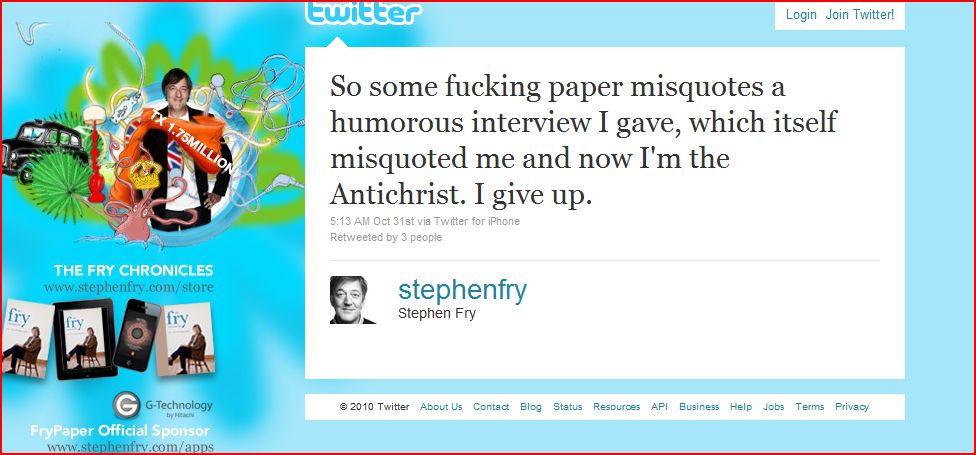
Fry has close to 2 million twitter followers and on the subject he tweeted: "So some f------- paper misquotes a humorous interview I gave, which itself misquoted me and now I'm the Antichrist. I give up."
Don't give up, Stephen. If you do, the bad people win.
You can use this link to read what Fry has to say, in his own words, about the silly "controversy" and the distortions that have claimed that he said women don't enjoy sex.