
EYE ON A CRAZY PLANET
Showing posts with label Aboriginal Rights. Show all posts
Showing posts with label Aboriginal Rights. Show all posts
Sunday, December 22, 2013


Monday, October 14, 2013
Selling a fake Canadian "genocide" for fun and profit
There have been far too many efforts at genocide in the last century. Some, like that of the Armenians by the Turks, are still denied by its perpetrators, and some, like that of the Sudanese Arabs against blacks, is ongoing. There are some that today openly aspire to commit genocide but lack the means, as the one Iran and its proxies Hezbollah and Hamas would like to inflict on Jews.
But those aren't the genocides that former bigshots, ex-Assembly of First Nations National Chief Phil Fontaine and the defunct Canadian Jewish Congress' old boss Bernie Farber have chosen to decry. Instead they are trying to sell the notion of a fake "genocide" against Canada's Native population in Canada's "national newspaper" and their motives may not be entirely altruistic.
There are nuances that even a generally true statement, such as that Canada's First Nations have received very poor treatment in the past, need to take into account. For one thing, Canada's First Nations are just that, nations, a plural. While Canada's Indian Act applies to them all, in reality, different aboriginal tribes have negotiated and received different treatment from the government. But in absolutely no case, from the foundation of Canada in 1867, could that treatment, in any instance, be described as genocide, which is a deliberate policy of killing an entire racial or ethnic group.
It should also be noted that many of Canada's aboriginal nations waged war on each other, committing mass-murders and driving one another off land in what in contemporary terms would be described at a minimum as "ethnic cleansing."

Canada's historical policies towards First Nations may have been unfair, patronizing and colonial, but to call them genocidal is quite simply a lie.
To really understand Canada's historical policies toward First Nations, we need to look at them in the context of their time and not, as Farber and Fontaine do, through a distorted, telescopic rear-view mirror imposing the values of 2013 on the Nineteenth Century.
Canada compared to the United States, or for that matter compared to government treatment of aboriginals in any part of the New World or under any ex-colonial power, was extremely benevolent. Without question, our 18th Century policies considered Native culture to be lesser to that of the Europeans. But to put the times in context, slavery had only been abolished in the United States four years before Canadian Confederation and there was no country in the world then in which women were entitled to vote.
For Native Americans at that time, Canada was not a genocidal slaughterhouse, but a refuge. After the massacre of Custer's troops at Little Big Horn, it was to Canada that Sitting Bull and a band of his followers came to find sanctuary. Today, in the Royal Ontario Museum, rests a headdress that Sitting Bull gave to Canada's Northwest Mounted Police as a gesture of gratitude for the safety for his people that this nation provided.
For anyone examining all the actual genocides in history, it is clear that the method and purpose was to first segregate, then to annihilate the intended target. Racist laws in countries that had genocidal policies, such as Nazi Germany's Nuremberg Laws, were enacted to prevent, not promote integration. There is no instance, ever, that the purpose of a genocide was to integrate one group with another. Yet, while it may offend contemporary cultural sensitivities, integration was the clearly stated intention of Canada's policies towards First Nations which Farber and Fontaine preposterously characterize as a "genocide."
Yes, there were abuses committed in Residential Schools many decades ago, for which Prime Minister Harper has apologized. But the worst of the abuses were perpetrated by corrupt individuals and were not part of any government policy.
The authors The Globe chose to promote, Farber and Fontaine, make a curious pair of "genocide" hucksters who may have driving motives other than their own particular concept of "social justice." Fontaine is a former National Chief who obviously craves the limelight, as does Farber. Beyond that, Farber now makes his living working for a company that needs to convince First Nations groups to let them build energy facilities on their land. Whether or not he believes that Canada committed a genocide, being seen as an extremist in their corner can't be bad for business.
However, that extremism comes at the cost of credibility. They are completely wrong in their inflammatory accusations and preposterous, ahistorical inventions such as that Sir John A. McDonald's policies towards aboriginals were genocidal attempts at mass murder.
And this says nothing of the facts about the current situation of First Nations in Canada. It would be a very curious form of genocide indeed that has resulted in First Nations being the fastest growing population in Canada. Last time I checked, that would make it the exact opposite of a genocide. Of course, this would not be the first time a group claimed a fake genocide, as their numbers are vastly increasing, solely for political aims.
But while what Fontaine and Farber have written in The Globe is a load of ridiculous, politicized nonsense, I don't want to give the impression that I don't think they aren't also sincere in their beliefs. After all, to borrow from and paraphrase H.L. Mencken, no one ever went broke by underestimating the intelligence of Bernie Farber.
But those aren't the genocides that former bigshots, ex-Assembly of First Nations National Chief Phil Fontaine and the defunct Canadian Jewish Congress' old boss Bernie Farber have chosen to decry. Instead they are trying to sell the notion of a fake "genocide" against Canada's Native population in Canada's "national newspaper" and their motives may not be entirely altruistic.
There are nuances that even a generally true statement, such as that Canada's First Nations have received very poor treatment in the past, need to take into account. For one thing, Canada's First Nations are just that, nations, a plural. While Canada's Indian Act applies to them all, in reality, different aboriginal tribes have negotiated and received different treatment from the government. But in absolutely no case, from the foundation of Canada in 1867, could that treatment, in any instance, be described as genocide, which is a deliberate policy of killing an entire racial or ethnic group.
It should also be noted that many of Canada's aboriginal nations waged war on each other, committing mass-murders and driving one another off land in what in contemporary terms would be described at a minimum as "ethnic cleansing."
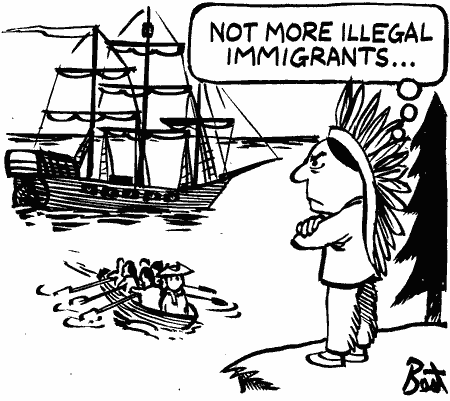
Canada's historical policies towards First Nations may have been unfair, patronizing and colonial, but to call them genocidal is quite simply a lie.
To really understand Canada's historical policies toward First Nations, we need to look at them in the context of their time and not, as Farber and Fontaine do, through a distorted, telescopic rear-view mirror imposing the values of 2013 on the Nineteenth Century.
Canada compared to the United States, or for that matter compared to government treatment of aboriginals in any part of the New World or under any ex-colonial power, was extremely benevolent. Without question, our 18th Century policies considered Native culture to be lesser to that of the Europeans. But to put the times in context, slavery had only been abolished in the United States four years before Canadian Confederation and there was no country in the world then in which women were entitled to vote.
For Native Americans at that time, Canada was not a genocidal slaughterhouse, but a refuge. After the massacre of Custer's troops at Little Big Horn, it was to Canada that Sitting Bull and a band of his followers came to find sanctuary. Today, in the Royal Ontario Museum, rests a headdress that Sitting Bull gave to Canada's Northwest Mounted Police as a gesture of gratitude for the safety for his people that this nation provided.
For anyone examining all the actual genocides in history, it is clear that the method and purpose was to first segregate, then to annihilate the intended target. Racist laws in countries that had genocidal policies, such as Nazi Germany's Nuremberg Laws, were enacted to prevent, not promote integration. There is no instance, ever, that the purpose of a genocide was to integrate one group with another. Yet, while it may offend contemporary cultural sensitivities, integration was the clearly stated intention of Canada's policies towards First Nations which Farber and Fontaine preposterously characterize as a "genocide."
Yes, there were abuses committed in Residential Schools many decades ago, for which Prime Minister Harper has apologized. But the worst of the abuses were perpetrated by corrupt individuals and were not part of any government policy.
The authors The Globe chose to promote, Farber and Fontaine, make a curious pair of "genocide" hucksters who may have driving motives other than their own particular concept of "social justice." Fontaine is a former National Chief who obviously craves the limelight, as does Farber. Beyond that, Farber now makes his living working for a company that needs to convince First Nations groups to let them build energy facilities on their land. Whether or not he believes that Canada committed a genocide, being seen as an extremist in their corner can't be bad for business.
However, that extremism comes at the cost of credibility. They are completely wrong in their inflammatory accusations and preposterous, ahistorical inventions such as that Sir John A. McDonald's policies towards aboriginals were genocidal attempts at mass murder.
And this says nothing of the facts about the current situation of First Nations in Canada. It would be a very curious form of genocide indeed that has resulted in First Nations being the fastest growing population in Canada. Last time I checked, that would make it the exact opposite of a genocide. Of course, this would not be the first time a group claimed a fake genocide, as their numbers are vastly increasing, solely for political aims.
But while what Fontaine and Farber have written in The Globe is a load of ridiculous, politicized nonsense, I don't want to give the impression that I don't think they aren't also sincere in their beliefs. After all, to borrow from and paraphrase H.L. Mencken, no one ever went broke by underestimating the intelligence of Bernie Farber.
Thursday, June 6, 2013
Toronto District School Board's Plan to Decolonize Education
 From The Propagandist Magazine:
A document published by the Toronto District School Board entitled Decolonizing Our Schools advocates discriminatory hiring practices, “decolonizing and indigenizing” curriculum, replacing traditional discipline with Aboriginal healing circles, and even forcing students to participate in Aboriginal religious ceremonies.
The TDSB instructs teachers to “prioritize Aboriginal people's concerns and worldviews”. Students are to be taught that Aboriginals in Canada are oppressed and therefore teachers and students should “understand Aboriginal people's activism as assertions of human and Indigenous rights”. Furthermore, all school principals should be required to “participate in decolonizing and indigenizing professional development”.
In this document, the TDSB outlines its discriminatory hiring practices.
h/t Matthew L
Wednesday, April 10, 2013
Bernie Farber's cognitive impairment
This is going to be one of those supercilious, parochial pieces referring to a blog piece written about still another blog posting, so if you're on-board for something as superfluous, keep reading...
The Huffington Post just published an article by the former head of the now defunct Canadian Jewish Congress, Bernie Farber, who is also a failed Liberal Party candidate for a seat in Ontario's provincial legislature.
Farber's article is all about taking issue with another Huff Po piece written by Frank Dimant, the current head of the Jewish advocacy organization B'nai Brith. In Dimant's piece, he notes that Canadian Jewish voter sentiment has moved from the Liberal Party to the Conservatives in the last few years, largely, he asserts, on the basis of the Harper government's strong support for Israel.
Among other prognostications, Dimant wrote that "There is already a movement that wants to neutralize Jewish support for the Conservative Party and the mantra is that all three parties have the same agenda regarding Israel, a two-state solution, so why do we have to support the Conservatives? In a well-orchestrated campaign we will soon begin to see a new Jewish agenda being proposed by some, which will advocate that Jewish community adjust its focus to Aboriginal issues, child poverty, health care and social housing."
Apparently very sensitive to criticism of the Liberal party and the potential shift against Israel it will take if his choice for leader takes the helm, Farber lashed out at Dimant, accusing the B'nai Brith head of launching an "attack on Canadian Jews who would dare identify themselves as Liberals."
It doesn't require a particularly close reading of Dimant's article to observe that no such attack is there, only a challenge to Conservatives to retain the Jewish vote and noting the politicized environment within that community.
Distorting things further, Farber spends a great deal of ink regarding his assertion that Dimant "insinuates that there is something "new" about Canadian Jews taking an interest in Aboriginal issues, child poverty and social housing. "
For Farber to actually be correct, it would necessitate the term "adjust its focus" meaning the same thing as beginning something "new."
He then digresses into the Jewish community's interest in social justice as manifested in Aboriginal rights, social housing, etc. All that is good and fine, but as is not uncommon for him, Farber completely missed (or obfuscated) the point of the matter.
It is no secret that an interest in Israel and its well-being is of major importance to a large segment of Canadian Jews. But that interest is certainly not to the exclusion of other concerns, and Dimant's point was that the Liberals in the Jewish community would be trying to readjust priorities in order to serve the party's electoral interests. A point that Farber's piece seems to unwittingly confirm.
Interestingly, Dimant even didn't challenge the idea that the "mantra" of all parties is to take an equal stand on Israel, though the facts would suggest otherwise. The Conservatives have taken a strong, unequivocally pro-Israel stance, the New Democrats have two Deputy Leaders, Libby Davies and Megan Leslie, who are openly hostile to Israel, and the Liberal Party falls somewhere in between, although perhaps leaning slightly towards Israel more than the Palestinian side.
But as Mitch Wolfe described in yet another Huff Po piece, that may change significantly assuming Justin Trudeau, whom Farber has endorsed, becomes the Liberal Party leader. Under Trudeau, there is every indication the Liberals will be even less favorable to the Jewish state. Justin Trudeau's brother Alexandre, who has the distinction of being his sibling's senior policy adviser, has cooperated with Iran's state propaganda service to make a pro-Iran, anti-Israel documentary, which clearly reflects his sentiments on the middle east situation.
Perhaps Bernie wanted to garner favor with his political party by changing the subject to deflect from his party selling Israel down the river. On the other hand, maybe he simply didn't understand Dimant's article.
The latter may indeed be the explanation. Last month on twitter, Farber implied opposition to a Toronto City Council motion giving amnesty to illegal immigrants was "racist." When I challenged him on that, his responses became incoherent, suggesting he didn't actually understand the issues he was discussing.
Bernie has every right to extol the supposed virtues of his political party and his chosen candidate. He has every right to promote the Liberal Party and his candidate as being the best choice for Canadian voters, though many would disagree. But Farber is perceived by some as a spokesperson for, and representative of Canada's Jewish community. This is very problematic when someone who has such little apparent regard for free speech is being presented as a community leader. He may represent the Liberal Party and the Justin Trudeau faction within it, but the only Jew on whose behalf Bernie Farber speaks is Bernie Farber.
The Huffington Post just published an article by the former head of the now defunct Canadian Jewish Congress, Bernie Farber, who is also a failed Liberal Party candidate for a seat in Ontario's provincial legislature.
Farber's article is all about taking issue with another Huff Po piece written by Frank Dimant, the current head of the Jewish advocacy organization B'nai Brith. In Dimant's piece, he notes that Canadian Jewish voter sentiment has moved from the Liberal Party to the Conservatives in the last few years, largely, he asserts, on the basis of the Harper government's strong support for Israel.
Among other prognostications, Dimant wrote that "There is already a movement that wants to neutralize Jewish support for the Conservative Party and the mantra is that all three parties have the same agenda regarding Israel, a two-state solution, so why do we have to support the Conservatives? In a well-orchestrated campaign we will soon begin to see a new Jewish agenda being proposed by some, which will advocate that Jewish community adjust its focus to Aboriginal issues, child poverty, health care and social housing."
Apparently very sensitive to criticism of the Liberal party and the potential shift against Israel it will take if his choice for leader takes the helm, Farber lashed out at Dimant, accusing the B'nai Brith head of launching an "attack on Canadian Jews who would dare identify themselves as Liberals."
It doesn't require a particularly close reading of Dimant's article to observe that no such attack is there, only a challenge to Conservatives to retain the Jewish vote and noting the politicized environment within that community.
Distorting things further, Farber spends a great deal of ink regarding his assertion that Dimant "insinuates that there is something "new" about Canadian Jews taking an interest in Aboriginal issues, child poverty and social housing. "
For Farber to actually be correct, it would necessitate the term "adjust its focus" meaning the same thing as beginning something "new."
He then digresses into the Jewish community's interest in social justice as manifested in Aboriginal rights, social housing, etc. All that is good and fine, but as is not uncommon for him, Farber completely missed (or obfuscated) the point of the matter.
It is no secret that an interest in Israel and its well-being is of major importance to a large segment of Canadian Jews. But that interest is certainly not to the exclusion of other concerns, and Dimant's point was that the Liberals in the Jewish community would be trying to readjust priorities in order to serve the party's electoral interests. A point that Farber's piece seems to unwittingly confirm.
Interestingly, Dimant even didn't challenge the idea that the "mantra" of all parties is to take an equal stand on Israel, though the facts would suggest otherwise. The Conservatives have taken a strong, unequivocally pro-Israel stance, the New Democrats have two Deputy Leaders, Libby Davies and Megan Leslie, who are openly hostile to Israel, and the Liberal Party falls somewhere in between, although perhaps leaning slightly towards Israel more than the Palestinian side.
But as Mitch Wolfe described in yet another Huff Po piece, that may change significantly assuming Justin Trudeau, whom Farber has endorsed, becomes the Liberal Party leader. Under Trudeau, there is every indication the Liberals will be even less favorable to the Jewish state. Justin Trudeau's brother Alexandre, who has the distinction of being his sibling's senior policy adviser, has cooperated with Iran's state propaganda service to make a pro-Iran, anti-Israel documentary, which clearly reflects his sentiments on the middle east situation.
Perhaps Bernie wanted to garner favor with his political party by changing the subject to deflect from his party selling Israel down the river. On the other hand, maybe he simply didn't understand Dimant's article.
The latter may indeed be the explanation. Last month on twitter, Farber implied opposition to a Toronto City Council motion giving amnesty to illegal immigrants was "racist." When I challenged him on that, his responses became incoherent, suggesting he didn't actually understand the issues he was discussing.
Bernie has every right to extol the supposed virtues of his political party and his chosen candidate. He has every right to promote the Liberal Party and his candidate as being the best choice for Canadian voters, though many would disagree. But Farber is perceived by some as a spokesperson for, and representative of Canada's Jewish community. This is very problematic when someone who has such little apparent regard for free speech is being presented as a community leader. He may represent the Liberal Party and the Justin Trudeau faction within it, but the only Jew on whose behalf Bernie Farber speaks is Bernie Farber.
Subscribe to:
Comments (Atom)